

As a seasoned traveler, I thought I'd seen it all, but nothing prepared me for the profound wisdom shared by a traditional Sangoma in rural South Africa. What started as curiosity morphed into a deeply personal journey, challenging my perceptions of healing, culture, and my own path forward.
The red dust of the KwaZulu-Natal countryside swirled around the tires of the ancient bakkie (pickup truck), painting the vibrant green landscape in a hazy, ochre glow. My heart, usually racing with the thrill of discovery, felt a strange mix of apprehension and exhilaration. I was heading to meet a traditional healer, a Sangoma, in a remote village hours outside Durban. Me, the self-proclaimed skeptic, the one who always looked for the scientific explanation, the logical answer. What was I even doing here?
For years, my life had been a whirlwind of passport stamps, exotic meals, and picture-perfect sunsets. I lived for the next adventure, the next story for Tripsora. But beneath the polished facade of a professional travel blogger, I was feeling…stuck. Burnout was a familiar companion, my creativity felt like a dry well, and a nagging sense of disconnection hummed beneath the surface of every new experience. I’d tried all the usual fixes: yoga retreats in Bali, silent meditation in Thailand, even a digital detox in the Amazon. They offered temporary relief, but the core restlessness remained.
It was during a particularly candid conversation with a local friend, Zola, in a bustling Durban market that the idea first surfaced. "You're looking for something deeper, aren't you?" she'd observed, her eyes twinkling. "You need to meet Ma Thandi. She sees things. Not just with her eyes, but with her spirit. She might help you find what you're truly searching for." My logical brain immediately conjured images of charlatans and tourist traps, but Zola's earnestness, and a desperate curiosity for something truly different, chipped away at my resistance. What if there was wisdom beyond the Western frameworks I knew? What if the "new possibilities" I craved weren't in another country, but in another way of seeing the world?
This wasn't just another travel experience; it was a leap of faith into a world I barely understood. And here’s what actually happened.
### The Whispers of Tradition: Why I Sought a Sangoma
My journey to Ma Thandi wasn't born of a sudden spiritual awakening, but rather a slow, creeping realization that my current approach to wellness wasn't working. I was constantly "on," chasing the next viral story, the next trending destination. My body felt it, my mind felt it, and my spirit, if I was honest, felt utterly depleted. The usual "wellness" solutions, while pleasant, felt like band-aids on a deeper wound.
Zola’s suggestion about a Sangoma was initially met with a raised eyebrow and a polite nod. I knew of traditional healers, of course, from my travels in various parts of the world. But my understanding was superficial, often colored by sensationalized media portrayals. Sangomas, I learned, are not just healers of the body; they are diviners, spiritual guides, counselors, and custodians of ancestral wisdom within many Southern African cultures, particularly the Zulu. They are called by the ancestors (thwasa) through dreams and visions, undergoing a rigorous training process. This wasn't just about a herbal remedy; it was about connecting with a lineage, a spiritual heritage.
"Ma Thandi lives simply," Zola explained. "She doesn't advertise. People come to her because her reputation is true. She helps people find their path, clear their spirits, understand their dreams. She connects with the ancestors." The idea of someone "seeing" beyond the surface, of understanding unspoken burdens, was both unsettling and incredibly alluring. My skepticism warred with a deep-seated longing for clarity.
After several days of contemplation, and a few more reassuring conversations with Zola about the respect and authenticity of Ma Thandi, I decided to go. Zola made the initial contact, explaining my situation and my genuine desire to understand and connect, not just observe. It was clear from the outset that this wasn't a show; it was a sacred exchange. The only "booking" involved was a respectful request and a confirmation of the best day for me to visit. The cost? Zola explained it wasn't a fixed price but an "offering" – a traditional way of showing gratitude and respect for the healer's time and spiritual energy. I prepared a generous amount in South African Rand (approximately R800, equivalent to about $45 USD at the time), along with a small gift of fresh fruit, as advised by Zola.
### The Journey to Ma Thandi's Kraal
The drive itself felt like a journey back in time, away from the modern pulse of Durban. The paved roads gave way to gravel, then to dusty tracks winding through rolling hills dotted with traditional Zulu homesteads – round, thatched-roof huts clustered together, surrounded by kraals for livestock. Children waved from the roadside, their laughter echoing in the vast, open air. The air grew cleaner, carrying the scent of woodsmoke and damp earth.
When we finally pulled up to Ma Thandi's homestead, the sun was beginning its slow descent, casting long shadows. It wasn't an imposing place, but humble and deeply rooted in its surroundings. A cluster of circular huts, meticulously maintained, formed a small kraal. Goats grazed peacefully nearby, and chickens pecked at the dust. It felt like a living, breathing part of the landscape.
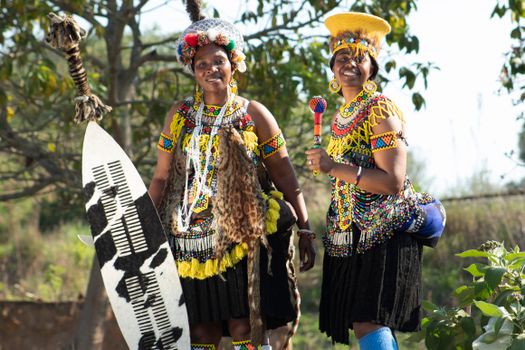
Zola led me to the entrance of one of the huts, smaller than the others, which she explained was Ma Thandi's ndumba – her consultation hut. As we approached, a woman emerged, her presence immediately commanding yet gentle. Ma Thandi. She was older than I'd imagined, perhaps in her late 60s, with kind, discerning eyes that seemed to hold centuries of wisdom. She wore a simple, brightly colored cloth wrapped around her, and strings of white beads adorned her neck and wrists – the traditional attire of a Sangoma. Her smile was warm, inviting, immediately dispelling much of my apprehension.
She greeted us in isiZulu, which Zola translated. Her voice was soft, melodic. She invited me into the ndumba. Inside, the air was cool and thick with the scent of dried herbs and woodsmoke. The floor was packed earth, meticulously swept. Around the perimeter were various objects: animal skins, gourds, small bottles of muthi (traditional medicine), and clusters of smooth, polished stones. A small fire smoldered in the center, its smoke curling lazily towards a vent in the thatched roof. It was a space of quiet power, almost sacred. I sat on a woven mat, my heart thrumming.
### Beyond Words: The Divination and the Healing Ritual
Ma Thandi sat opposite me, her gaze steady. There was no small talk, no superficial questions. She simply observed, her eyes seemingly piercing through my carefully constructed facade. She then began the divination. With a deep breath, she reached for a small, intricately carved wooden bowl filled with various objects: bones, shells, seeds, dice-like pieces. These were her amathambo – the "bones" through which the ancestors speak.
She rattled the bowl, chanting softly in isiZulu, her voice a low, resonant hum that vibrated through the hut. Then, with a flick of her wrist, she cast the amathambo onto a mat between us. They scattered, clattering softly, each piece landing in a specific position. Ma Thandi leaned forward, her eyes scanning the arrangement, her brow furrowed in concentration.
What followed was nothing short of astonishing. She began to speak, slowly at first, then with more fluidity, Zola translating her every word. She spoke of my restlessness, my feeling of being adrift despite my outward successes. She spoke of a creative blockage, of a fear of truly committing to my own voice. She even mentioned a specific, unaddressed grief from my past, something I rarely spoke about, a subtle weight I carried. It was as if she had opened my diary and read its most private entries. Tears welled in my eyes, not of sadness, but of profound recognition. This wasn't generic advice; it was deeply, intimately personal.
"The ancestors show me you carry much, but you do not release it," Zola translated Ma Thandi's words. "Your spirit seeks connection, but your mind guards it too tightly. You are like a river trying to flow with many stones in its path."
Ma Thandi then explained that the ancestors were calling for a cleansing, a ritual to remove the "stones" and allow my spirit to flow freely again. It wasn't a single, quick fix, but a multi-part process that would involve connecting with the elements and my own inner strength. I readily agreed.
The ritual began with a muthi bath. Ma Thandi prepared a large basin of warm water infused with various herbs, their scent earthy and pungent. She instructed me to wash my hands and face, then my feet, reciting a simple prayer of release. It was a symbolic act, washing away the old, preparing for the new. Next, she lit a small bundle of dried herbs, creating a fragrant smoke that she wafted around me, chanting and drumming softly on a small hand drum. The rhythmic sound, combined with the smoke and Ma Thandi's resonant voice, created a trance-like atmosphere. I felt a deep sense of calm, a surrender I hadn't experienced in years.
She then guided me through a visualization, asking me to picture my "stones" – my burdens, my fears – being lifted and carried away by the smoke, dissolving into the vast sky. It was a powerful, almost tangible experience. I felt a lightness, a subtle shift within my chest. The ritual concluded with Ma Thandi placing her hands gently on my head and shoulders, offering a final blessing, her words a soft hum of ancestral wisdom. The entire session, from divination to healing, lasted almost two hours, but time seemed to lose all meaning within the ndumba.
### The Aftershocks: What Shifted Immediately
Stepping out of Ma Thandi's ndumba into the cool evening air felt like emerging from a dream. The stars were beginning to pepper the vast African sky, and the village sounds – distant cattle, children’s voices – seemed sharper, more vibrant. Physically, I felt an odd mix of exhaustion and exhilaration. My limbs felt heavy, yet my head felt remarkably light, clear. Emotionally, I was raw, vulnerable, yet imbued with a profound sense of peace. The tears I had shed during the divination felt like a true release, washing away layers of unacknowledged emotional baggage.
Ma Thandi, with a gentle smile, offered a final piece of advice through Zola. "The journey of healing does not end here. It begins now. Listen to your dreams. Trust your intuition. The ancestors have shown you the path; it is for you to walk it." She gave me a small pouch of dried herbs, instructing me to add them to my bath water for the next few days, a continued cleansing.
The drive back to Durban was quiet, filled with my own thoughts. I didn't reach for my phone to scroll or check emails. Instead, I simply watched the passing landscape, the moon rising over the hills, feeling an unprecedented sense of presence. I felt lighter, as if a heavy cloak had been lifted from my shoulders. The persistent hum of anxiety that had been my constant companion for so long had quieted. I found myself journaling extensively that night, trying to capture every detail, every emotion. My initial skepticism had dissolved, replaced by a deep respect and a sense of wonder. I had entered Ma Thandi's homestead as a curious traveler; I left as someone profoundly touched by an ancient wisdom.
### New Horizons: The Lasting Impact on My Life and Travels
The encounter with Ma Thandi wasn't a magic bullet that instantly solved all my problems, but it was a powerful catalyst. The "new possibilities" she opened weren't external opportunities, but internal shifts that profoundly impacted my life and my approach to travel.
Firstly, my perspective on wellness underwent a radical transformation. I began to view health not just as the absence of physical illness, but as a holistic balance of mind, body, and spirit, deeply intertwined with one's ancestral lineage and connection to the earth. I started incorporating more mindful practices into my daily routine, not as a chore, but as a genuine act of self-care. I slowed down, prioritized rest, and reconnected with my own creative impulses, allowing them to flow more freely, unburdened by the pressure to constantly produce. My writing, I found, became more authentic, more resonant.
Secondly, my understanding and appreciation for traditional cultures deepened immensely. I moved beyond a superficial appreciation of "exotic" customs to a profound respect for indigenous knowledge systems. I learned that traditional healing isn't just about folklore; it's a sophisticated, deeply integrated system of understanding the human condition and its place within the natural and spiritual worlds. It taught me to approach other cultures with even greater humility and an open heart, seeking to learn rather than to judge or merely observe.
The biggest shift, however, was internal. Ma Thandi's words about the "stones in my path" resonated deeply. I began to actively acknowledge and process long-held fears and unresolved emotions that had been subtly dictating my choices. I started making decisions from a place of intuition and inner knowing, rather than solely relying on logic or external validation. This newfound clarity allowed me to navigate challenges with greater resilience and to embrace uncertainty as a part of life's rich tapestry. My travels, once a means of escape, became a deeper exploration of connection – to places, to people, and to myself. I found myself seeking out more authentic, immersive experiences, valuing genuine human connection over curated tourist attractions. The experience truly opened my mind to the idea that there is more to healing, and to life, than what our modern, Western-centric world often acknowledges.
### Considering Your Own Journey: Practical Tips & Ethical Engagement
My experience with Ma Thandi was transformative, and if you're feeling a similar pull towards traditional healing, here are some practical tips and ethical considerations to guide your own journey:
1. Research is paramount: Traditional healers are deeply respected figures within their communities. Don't just show up expecting a session. Ask trusted locals for recommendations. In South Africa, look for Sangomas or Inyangas (herbalists). In other parts of the world, research the specific traditional healing practices of that culture. Word-of-mouth and community standing are often the best indicators of a genuine, reputable healer.
2. Approach with Respect and Humility: This is not a tourist attraction or a "spiritual shopping" experience. Go with an open mind, a respectful attitude, and a genuine desire to learn and connect. Understand that you are entering a sacred space and engaging with deeply held cultural beliefs. Avoid appropriation or treating the experience as mere entertainment.
3. Manage Expectations: Traditional healing is often very different from Western medical practices. It might not be what you expect, and that's okay. Go without a rigid agenda or preconceived notions of what "should" happen. Be open to discomfort, to challenging your own beliefs, and to the possibility that the healing may be subtle, internal, and long-term.
4. Understand the "Offering": In many traditional cultures, healers do not have fixed prices. Instead, you offer a gift or a donation (like my R800 + fruit for Ma Thandi) as a sign of gratitude and respect for their time, wisdom, and spiritual energy. Ask discreetly beforehand what is customary, or consult a local friend. Always offer generously and respectfully.
5. Safety and Authenticity: Unfortunately, as with any practice, charlatans exist. Rely on trusted local recommendations. A genuine healer will be deeply integrated into their community, known for their integrity, and will never make outlandish promises or demand exorbitant fees.
6. Be Prepared for a Language Barrier: Unless you speak the local language, you'll likely need an interpreter. Zola was invaluable in translating Ma Thandi's isiZulu. This is crucial for truly understanding the messages and participating fully in the process.
7. Integration is Key: The healing doesn't end when you leave the session. Be prepared to integrate the insights and advice into your daily life. Journal, reflect, and make conscious choices to honor the wisdom you've received.
### A New Chapter: The Ongoing Journey
My encounter with Ma Thandi was more than just a travel anecdote; it was a profound reset button for my life. It taught me that sometimes, the most expansive journeys aren't across continents, but within the depths of our own being, guided by ancient wisdom. It opened my mind to the vast, interconnected possibilities of healing, culture, and personal growth that lie beyond the familiar.
If you find yourself feeling stuck, restless, or simply curious about the deeper currents of the world, I urge you to step outside your comfort zone. Embrace the unexpected. Seek out the wisdom that lies in the quiet corners of the world, in the traditions that have sustained communities for centuries. You might just find, as I did, that a traditional healer can open your mind to possibilities you never even knew existed.
What's the most unexpected spiritual or cultural encounter you've had on your travels? Share your stories in the comments below! Let's inspire each other to travel not just with our eyes, but with our hearts and minds wide open.
Visual journey



Tags
Share this adventure
Join the travel community
New adventures, cultural insights and travel inspiration, straight to your inbox.
We may receive a commission if you click on a link and buy a product, service or policy, at no extra cost to you. How affiliate links work.
Other angles on this trip
These notes are written by AI to show how different kinds of traveller might see this destination. They are not comments from real readers.