
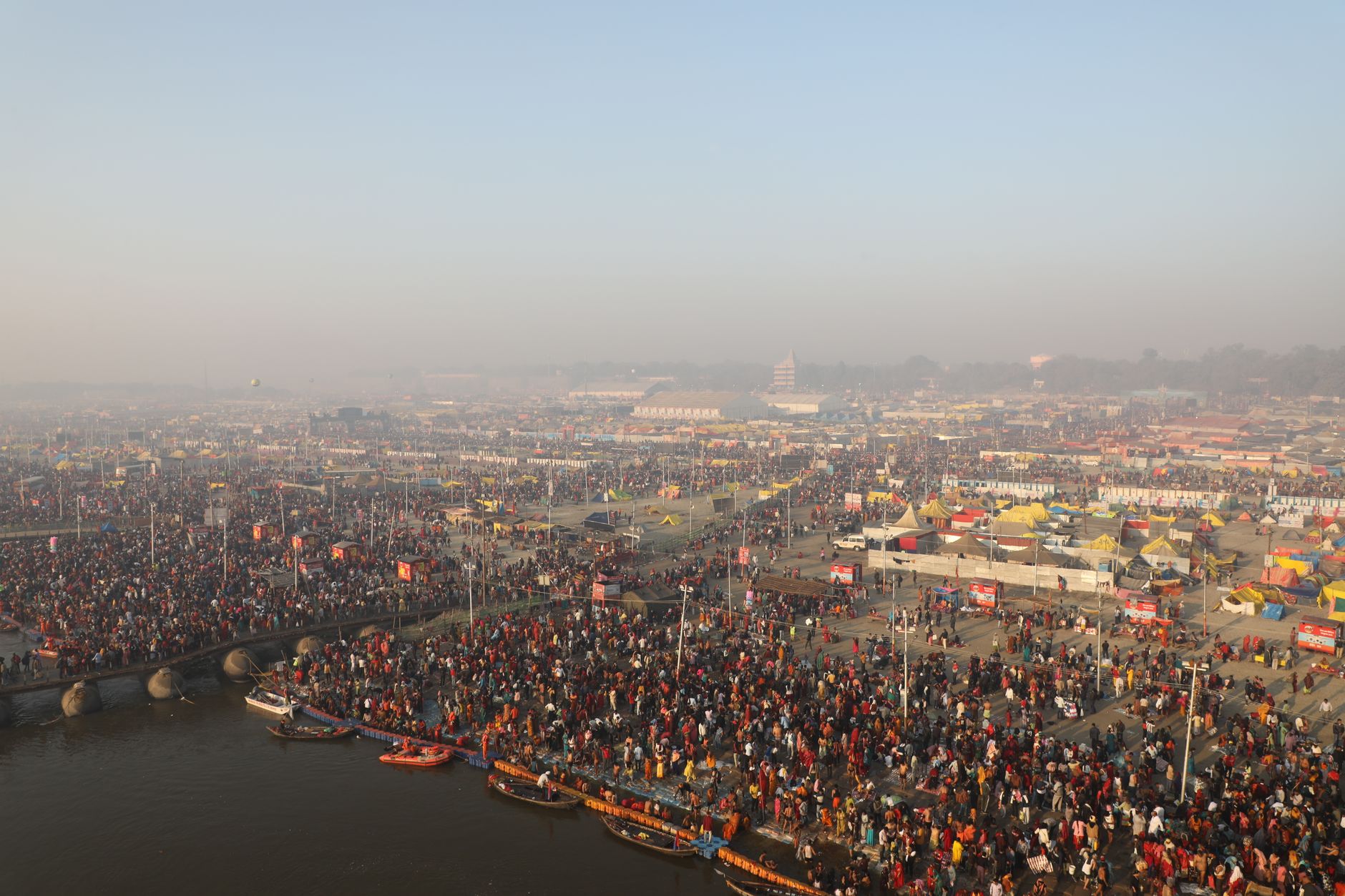
Imagine a celebration so vast, it's visible from space, yet few outside India truly grasp its scale. I immersed myself in the Maha Kumbh Mela, joining millions in an ancient ritual that transcends language and belief. This isn't just a festival; it's a universe of faith, wonder, and human connection you absolutely need to experience. ---
The year was 2019, and I was standing on the banks of the mighty Ganges River in Prayagraj, India. Dawn was breaking, painting the sky in hues of soft orange and rose, reflecting off the water. Around me, as far as the eye could see, were people. Not just hundreds, not thousands, not even hundreds of thousands. Millions. An estimated 50 million people had gathered on that single day, all with one purpose: to take a holy dip in the sacred waters during the Kumbh Mela.
You’ve probably heard of Carnival in Rio, Oktoberfest in Munich, or even the Lantern Festival in Taiwan. They’re vibrant, iconic, and draw massive crowds. But have you ever heard of a gathering so immense, it creates its own temporary city spanning over 2,000 hectares, complete with hospitals, police stations, and a meticulously planned infrastructure, all built from scratch in a matter of months, only to be dismantled just as quickly? I hadn’t, not really. Until I decided to dive headfirst into the phenomenon that is the Kumbh Mela, an event that celebrates with more people than the entire population of many countries, yet often flies under the radar of mainstream global tourism.
It was an experience that fundamentally reshaped my understanding of faith, community, and the sheer power of human devotion. And trust me, it’s an experience you absolutely need to add to your bucket list.
### What is the Kumbh Mela? A Universe of Faith on Earth
Let's get one thing straight: the Kumbh Mela isn't just a festival; it's a pilgrimage, a spiritual marathon rooted in ancient Hindu mythology. Legend has it that gods and demons once fought over a pot (Kumbh) containing the elixir of immortality (Amrita). During the epic struggle, a few drops of this nectar spilled at four specific locations in India: Prayagraj (formerly Allahabad), Haridwar, Nashik, and Ujjain. The Kumbh Mela is celebrated sequentially at these four sites, with a major Purna Kumbh Mela occurring every 12 years at Prayagraj, at the sacred confluence (Triveni Sangam) of the Ganges, Yamuna, and mythical Saraswati rivers. The next major Purna Kumbh Mela in Prayagraj is scheduled for early 2025, making this the perfect time to start planning!
The scale is staggering. The 2019 Kumbh Mela saw over 240 million visitors over its 50-day duration, with peak bathing days (known as "Snans") drawing tens of millions. Imagine a temporary city, larger than many permanent ones, pulsating with life, devotion, and an energy unlike anything you've ever felt. It’s a place where time seems to bend, and the modern world fades into a vibrant tapestry of ancient rituals.
My journey began with skepticism, perhaps a touch of trepidation. How does one navigate a crowd of millions? What about safety, hygiene, scams? All valid concerns, which I’ll address, but what I found was an incredibly well-organized, albeit chaotic, spiritual marvel.
### My First Dip: The Holy Snan and the Naga Sadhus
The heart of the Kumbh Mela is the ritual bath, or 'Snan', in the holy waters. It's believed that a dip during this auspicious time cleanses sins and brings salvation. I chose to experience one of the major Snan days – the Mauni Amavasya, a new moon day considered particularly potent.
We arrived at the Mela grounds before dawn. The air was crisp, carrying the scent of woodsmoke, incense, and damp earth. A low hum of chanting and distant bells filled the vast expanse. As the first rays of sun kissed the horizon, painting the sky in fiery oranges and deep purples, the true spectacle began.
From a distance, I heard a roar, growing louder, like an approaching storm. Then, they appeared: the Naga Sadhus. These ascetic saints, naked except for a smear of ash on their bodies and often dreadlocked hair, are renunciates who live in caves and mountains, emerging only for the Kumbh Mela. Their procession to the river is a powerful, almost primal sight. They marched, some dancing wildly, others serene, carrying tridents and blowing conch shells, their eyes burning with an otherworldly intensity. The crowd parted respectfully, a palpable wave of reverence washing over us. It was like witnessing a scene from an ancient epic.
Joining the throng of millions heading towards the Sangam was an exercise in controlled chaos. There was a sense of collective purpose, a shared devotion that transcended individual identities. People walked hand-in-hand, families clutched each other, and strangers offered smiles and assistance. The sheer weight of humanity was immense, yet strangely comforting.
When it was my turn, I waded into the surprisingly chilly water of the Ganges. The current was gentle, and the early morning light shimmered on the surface. I closed my eyes, took a deep breath, and immersed myself three times, as is customary. It wasn't just a bath; it was an act of surrender, a moment of profound connection to something ancient and immense. Emerging from the water, I felt a lightness, a sense of renewal that words can barely capture. It was truly transformative.
### Beyond the Bath: A City of Faith and Wonders
But the Kumbh Mela is so much more than just the holy dip. It’s a temporary city, a vibrant microcosm of India itself, constructed with astonishing precision and speed. After my bath, I spent days exploring this ephemeral metropolis, and every corner offered a new marvel.
The Mela grounds are divided into sectors, each hosting various ashrams (hermitages), spiritual camps, and charitable organizations. I wandered through lanes lined with colorful tents, each emanating a different energy. One moment, I was listening to a philosophical discourse by a revered guru; the next, I was mesmerized by a group of musicians playing traditional instruments, their melodies weaving through the air.
I saw Sadhus of all sects – the Urdhawavahurs, who hold their arms aloft for years; the Parivrajakas, who wander constantly; and the Shirshasinis, who stand on their heads. Each had a story, a path of devotion that was both unique and deeply inspiring. While some Sadhus prefer solitude, many were open to respectful interaction, offering blessings or sharing snippets of their wisdom. I sat for hours, sipping chai, observing, and occasionally engaging in broken Hindi conversations, feeling a profound connection to these diverse spiritual seekers.
Food was another adventure. Dozens of makeshift kitchens, or 'langars', run by volunteers, offered free meals to pilgrims, embodying the spirit of 'seva' (selfless service). I enjoyed simple yet delicious vegetarian thalis, often sitting cross-legged with strangers who quickly became companions. Beyond the langars, street vendors hawked everything from piping hot samosas and jalebis to fresh sugarcane juice. Prices were incredibly low – you could easily eat a hearty meal for less than $2-3.
The atmosphere was one of incredible unity. Despite the massive crowds, there was a palpable sense of peace and shared purpose. People from all walks of life, rich and poor, young and old, educated and unlettered, came together, shedding their worldly distinctions in the pursuit of spiritual merit. It’s an incredibly moving sight, a testament to the enduring power of faith.
### Navigating the Mela: Practical Tips for First-Timers
Experiencing the Kumbh Mela requires some planning, but it's absolutely doable for any adventurous traveler.
Best Time to Visit:
The Mela runs for about 50 days. While any day offers a unique experience, the most auspicious and crowded days are the 'Snan' days (royal baths). These are when the Naga Sadhus and other holy orders take their processions and dips. Attending a Snan day offers the most iconic experience, but be prepared for massive crowds. If you prefer a slightly less intense atmosphere, visit between the major Snans to explore the camps and engage with pilgrims. For the 2025 Purna Kumbh Mela in Prayagraj, key dates will be announced, but generally, January-February are the months.
Getting There:
* Flights: Fly into a major international airport like Delhi (DEL), Lucknow (LKO), or Varanasi (VNS). From there, you'll travel to Prayagraj.
* Train: Indian Railways is an excellent way to reach Prayagraj Junction (PRY). Book well in advance, especially during the Mela, as trains will be packed. Sleeper class offers an authentic (and budget-friendly) experience, while AC classes provide more comfort.
* Bus/Taxi: From nearby cities, buses and shared taxis are readily available. Roads around the Mela grounds are often closed to private vehicles on major Snan days, so be prepared to walk or use cycle rickshaws for the last stretch.
Accommodation:
The Mela administration sets up a vast tent city.
* Budget: Simple tents (dorm-style or small private) can be booked through various ashrams or government-run camps. Expect basic amenities – shared bathrooms, cots, and blankets. Prices can be as low as $10-30 per night.
* Mid-Range/Comfort: Several private tour operators and spiritual organizations offer more comfortable tented camps with attached Western-style bathrooms, proper beds, and even dining facilities. These can range from $50-150 per night.
* Luxury: Some luxury tented camps offer glamping experiences with all modern amenities, gourmet food, and dedicated guides. These can go upwards of $200-400 per night.
* Hotels: Hotels in Prayagraj city itself are limited and get booked out quickly. They also require travel to and from the Mela grounds daily.
Food & Water:
Stick to freshly cooked vegetarian food. Langars are safe, but exercise caution with street food. Always drink bottled water or use a reliable water filter/purifier. Carry rehydration salts.
Health & Safety:
* Crowd Management: On Snan days, follow instructions from police and volunteers. Move slowly with the crowd. Avoid pushing. If you feel overwhelmed, step aside if possible.
* Valuables: Keep passports, money, and phones secure in a money belt or inside pockets. Be vigilant against pickpockets.
* Hygiene: Public toilets are set up, but conditions can be basic. Carry hand sanitizer.
* Medical: The Mela has temporary hospitals and medical camps. Familiarize yourself with their locations. Carry a basic first-aid kit (band-aids, antiseptic, pain relievers, stomach medicine, rehydration salts).
* Lost & Found: There are designated police booths for lost persons and items. Have a meeting point with your travel companions. Write down your hotel/camp address and phone number.
* Sun Protection: Days can be sunny. Wear a hat, sunglasses, and sunscreen.
* Footwear: You’ll be walking a lot on sandy and uneven terrain. Comfortable, sturdy, closed-toe shoes are a must.
What to Pack:
* Modest clothing (shoulders and knees covered for both men and women). Lightweight cotton is ideal.
* Warm layers for chilly mornings and evenings (especially in January/February).
* Scarf or shawl (useful for modesty, sun protection, and warmth).
* Reusable water bottle.
* Power bank for your phone.
* Small backpack for day trips.
* Torch/headlamp (camps can be dimly lit at night).
* Wet wipes and hand sanitizer.
* Toiletries, including toilet paper.
### Cultural Immersion and Ethical Travel
The Kumbh Mela is a profoundly spiritual event. Approach it with an open mind, curiosity, and respect.
* Photography: While many Sadhus and pilgrims are open to being photographed, always ask for permission first. A simple nod or hand gesture is usually enough. Avoid intrusive flash photography during rituals.
* Interaction: Be polite and respectful. Acknowledge greetings like "Namaste." If you engage in conversation, listen more than you speak. Avoid sensitive topics like politics or religion unless initiated by the other person.
* Dress Code: Modest attire is essential. It shows respect for the culture and helps you blend in.
* Offerings: You might see people making offerings at the river or to Sadhus. This is a personal choice; never feel pressured to give money. If you wish to offer, do so respectfully.
* Plastic: While efforts are made to keep the Mela clean, plastic waste is a challenge. Minimize your plastic consumption and dispose of waste responsibly.
### Budgeting for the Mela: From Shoestring to Serene
The Kumbh Mela can be experienced on almost any budget.
* Flights: International flights to India can range from $500 - $1200+ depending on your origin and booking time.
* Domestic Transport: Trains are incredibly affordable. A 2nd-class sleeper from Delhi to Prayagraj might be $10-15. AC classes $30-50. Buses are even cheaper.
* Accommodation:
* Budget: Staying in a basic tent or opting for a free langar stay (if available and you're comfortable with very basic conditions) can cost $0-$30/night.
* Mid-Range: Comfortable tented camps are usually $50-150/night.
* Luxury: High-end glamping experiences can be $200-400+/night.
* Food: Eating at langars is free. Street food is typically $1-5 per meal. Mid-range restaurants (if you venture into the city) might be $10-20.
* Personal Expenses: Chai, snacks, small souvenirs, and local transport will add up. Budget $10-30 per day for this.
Overall:
A comfortable mid-range trip for a week, including flights from a major international hub, could be around $1500-2500. A budget traveler could do it for $800-1200, excluding international flights.
### Why You Must Experience It
Stepping away from the Mela, I carried with me not just memories, but a profound shift in perspective. I had witnessed the human spirit in its most raw, devoted, and communal form. I had seen millions unite for a shared spiritual purpose, creating a temporary world born of faith and dismantled with grace.
The Kumbh Mela isn't just a place to visit; it’s an experience to be absorbed. It’s a challenge to your senses, a feast for your eyes, and a balm for your soul. It’s an adventure that pushes you out of your comfort zone and into a realm of ancient traditions, vibrant colors, and unparalleled human connection. You will be a tiny speck in a sea of humanity, yet feel more connected than ever.
It's a journey that few outside of India truly understand, a celebration of millions that often goes unacknowledged in global travel narratives. But for those who answer its call, it offers a glimpse into something truly extraordinary.
So, as you plan your next adventure, consider swapping the usual tourist haunts for something truly monumental. Start saving, start planning, and prepare to be one of the millions who discover the untold wonders of the Kumbh Mela. Your soul will thank you.
---
Visual journey


Tags
Share this adventure
Join the travel community
New adventures, cultural insights and travel inspiration, straight to your inbox.
We may receive a commission if you click on a link and buy a product, service or policy, at no extra cost to you. How affiliate links work.
Been there?